
Searchable HTML
April 2025 Newsletter
Searchable HTML edition of April 2025 Newsletter from Extreme Indoor Golf in London, Ontario.
Searchable HTML edition: All document text is available below. Open the original page design only when you want the visual layout.
Page 1
Readable transcript
Extreme Indoor Golf EDITION 3 APRILNEWSLETTER Stop Guessing and StartSticking It at 118 Yards Standing 118 yards from the pin, I reach for my pitching wedge without hesitation. But should you? Not necessarily. After two decades teaching at Pine Valley and watching thousands of amateur swings, I've learned that the "right club" varies
wildly from player to player. "What club do you hit from 118?" might be the most common question I get during lessons, and my answer always starts with another question: "Well, what are you trying to do with the shot?" Truth is, there's no universal answer. My playing partner Dave, built like a linebacker with hands like catcher's mitts,
pulls his gap wedge for 118. Meanwhile, Sarah, who manages incredible tempo despite her petite frame, might pull 9-iron depending on conditions. Yesterday, I watched a student hit five consecutive shots with his pitching wedge, landing between 116-120 yards each time. An hour later, a different student hit pitching wedge distances ranging from
105-135 yards. Guess which one breaks 80 regularly? Wind complicates everything. A 10mph headwind might require clubbing up, while the same breeze at your back could mean choking down on a gap wedge. Morning dew can kill roll, while afternoon hardpan might add fifteen yards of bounce. Pin placement changes the equation too.
Back pin with trouble behind? Maybe that smooth 9-iron isn't worth the risk. Front pin with a false front? Your pitching wedge had better have some serious spin. Beyond the technical aspects, there's the mental game. I've seen too many players reach for "what they should hit" rather than what their gut tells them. That's tournament golf suicide.
The real answer comes from knowing your game – not just your full-swing distances, but your three-quarter shots, your punch shots, your high cuts. Spend time on the range with a measuring device, and you'll discover your tendencies. Your club selection at this distance reveals volumes about your game. Beginners often reach for 8 or even 7-
irons, compensating for inconsistent contact. Mid-handicappers typically fall somewhere between pitching wedge and 9-iron. And scratch golfers? They're not just choosing clubs by distance – they're factoring in trajectory, spin, and landing zones. Gordon L. Kier
View original page design

Page 2
Readable transcript
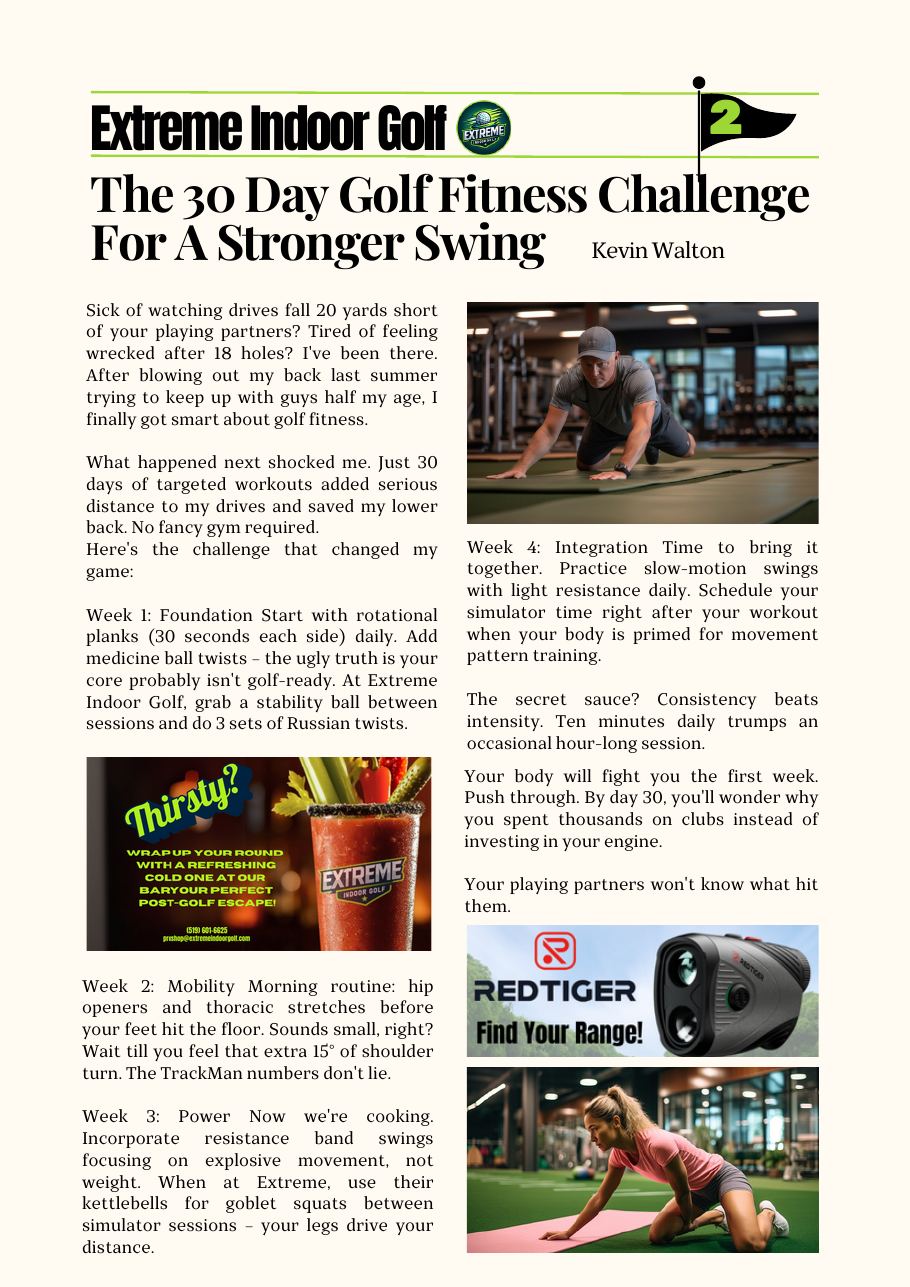
Extreme Indoor Golf Week 4: Integration Time to bring it together. Practice slow-motion swings with light resistance daily. Schedule your simulator time right after your workout when your body is primed for movement pattern training. The secret sauce? Consistency beats intensity. Ten minutes daily trumps an occasional hour-long session.
Your body will fight you the first week. Push through. By day 30, you'll wonder why you spent thousands on clubs instead of investing in your engine. Your playing partners won't know what hit them. The 30 Day Golf Fitness ChallengeFor A Stronger Swing Sick of watching drives fall 20 yards short of your playing partners? Tired of feeling
wrecked after 18 holes? I've been there. After blowing out my back last summer trying to keep up with guys half my age, I finally got smart about golf fitness. What happened next shocked me. Just 30 days of targeted workouts added serious distance to my drives and saved my lower back. No fancy gym required. Here's the challenge that changed my game:
Week 1: Foundation Start with rotational planks (30 seconds each side) daily. Add medicine ball twists – the ugly truth is your core probably isn't golf-ready. At Extreme Indoor Golf, grab a stability ball between sessions and do 3 sets of Russian twists. 2 Week 2: Mobility Morning routine: hip openers and thoracic stretches before
your feet hit the floor. Sounds small, right? Wait till you feel that extra 15° of shoulder turn. The TrackMan numbers don't lie. Week 3: Power Now we're cooking. Incorporate resistance band swings focusing on explosive movement, not weight. When at Extreme, use their kettlebells for goblet squats between simulator sessions – your legs drive your distance.
Kevin Walton
View original page design
Page 3
Readable transcript
Extreme Indoor Golf Nothing works up an appetite quite like crushing drives for an hour. Good thing The Putter’s Pub sits right inside Extreme Indoor Golf, saving you from that desperate post-round McDonald's run. I swung by last Tuesday after my simulator session and finally tried those wings everyone keeps talking about. The
Mississippi honey BBQ absolutely destroyed my white golf shirt, worth it. My playing partner Dave went with the dry rub lemon pepper instead. Smarter man than me. Their poutine game deserves serious attention. Skip the regular and go straight for the crunchy chicken version with that BBQ Ranch sauce they make in-house. It's
what Canadian comfort food dreams are made of after you've just three-putted six times in virtual Pebble Beach. The Putter’s Pub Serves UpQuality Bites and Craft Beer The turkey apple brie sandwich feels almost too fancy for a golf pub, but somehow works perfectly with Cameron's Cosmic Cream Ale. At $7.25 a can, the local brews won't break the bank either. 3
Speaking of drinks, their Transfusion cocktails have become something of a post-round tradition. Triple Bogey vodka mixed with ginger and grape, sounds weird, tastes incredible, and at 6% will take the sting out of that double bogey on 18. What makes Putter’s different is how it bridges the gap between decent golf facility
food and actual destination dining. The staff remembers your name and drink order by your second visit. Next time you're hitting balls at Extreme Indoor Golf (1790 Dundas East), budget an extra hour for The Putter’s. Your stomach will thank you, even if your scorecard doesn't. Ryan McTavish
View original page design

Page 4
Readable transcript
Three Indoor Golf Obstacles ToTackle Before Spring Extreme Indoor Golf Winter's grip is loosening, and soon Ontario's courses will beckon. But smart golfers know these final indoor weeks matter most. At Extreme Indoor Golf, we've been watching players transform their games with these three challenges: The Precision Putt-Off has humbled even
scratch golfers. Ten consecutive putts sounds simple until you're standing over that eighth attempt with shaky hands. My buddy Dave still talks about breaking the streak on his final putt last March. These final indoor sessions reveal more about your game than you'd think. While everyone else dusts off rusty swings in
April, you'll be ready to attack pins from day one 4 Nothing builds confidence like watching your drive sail past your personal best. The Long Drive Showdown brings out something primal in everyone. Just yesterday, a quiet guy who has been coming in all winter finally unleashed a monster drive that left everyone in his group watching in disbelief. Sometimes
pressure creates diamonds. My personal favorite? Playing a famous hole daily for 10 days straight. Tackling Amen Corner without the Augusta pressure lets you experiment with approaches you'd never try during your annual trip south. Your Winter GolfHabit Is About ToPay Off Big Time Let's be honest – Canadian golfers spend
winter dreaming of grass and cursing snow. Not you. You've been grinding at Extreme Indoor Golf while buddies hibernated. Now it's showtime, and guess who's about to look like a genius? Remember walking into Extreme last November? Your swing was "end-of-season rusty." But something magical happens when you see your swing path on a screen.
Progress. Real progress. The simulator doesn't lie – that slice from last summer has vanished. Your wedge control is suddenly deadly accurate. And that putting stroke? Smooth as butter, while courses were buried under snow. Here's the secret about indoor golf: it's BETTER for fixing issues. No distractions, consistent conditions, and immediate
feedback. Smart players are booking final tune-up sessions now. Rob Gibbons Gordon L. Kier
View original page design