
Searchable HTML
May 2025 Newsletter
Searchable HTML edition of May 2025 Newsletter from Extreme Indoor Golf in London, Ontario.
Searchable HTML edition: All document text is available below. Open the original page design only when you want the visual layout.
Page 1
Readable transcript
Extreme Indoor Golf EDITION 4 MAYNEWSLETTER The Forgotten Art of the 30-Foot Putt Most amateur golfers spend hours perfecting their drives and approach shots, but I've noticed something troubling during my 18 years of teaching: the alarming neglect of medium-range putts. "I'd rather practice my wedges," Jason told me last week during our session. Two
hours later, he three-putted four times in our nine-hole playing lesson. The irony wasn't lost on him. The statistics don't lie. PGA Tour pros make only 15% of their 30-foot putts, yet they practice them religiously. The average 15-handicapper? They're lucky to sink 3% from that distance, turning potential pars into frustrating bogeys.
During Tuesday's clinic, I had eight students hit five 30-footers each. Only one putt found the bottom of the cup. More concerning? Green reading becomes exponentially more important beyond 20 feet. What looks like a straight putt might have subtle double-breaks invisible to the untrained eye. I've watched countless students aim
straight at the hole when the proper line was nearly two feet right. Temperature affects long putts dramatically. That 30-footer that rolled perfectly at 9am might be lightning-fast by afternoon when the greens have dried out. Seasonal changes matter too - that same putt might require 20% more force in spring compared to summer.
The most effective drill? Place tees forming a 3-foot circle around the hole, then practice 30-footers with the sole goal of stopping the ball inside that circle. Your make percentage will naturally improve once you master distance control. Your approach to these medium-range putts reveals your golfing maturity. Beginners aim directly at the cup, hoping
for miracle makes. Intermediate players just try to get close. But skilled golfers visualize the entire journey of the ball, respecting both break and pace equally. Six putts finished more than six feet from the hole, creating challenging second putts. Distance control matters more than direction from 30 feet. Against conventional wisdom, I'd rather see you
consistently leave putts 2-3 feet short than blow them 6 feet past. The math is simple: leaving it short guarantees a miss, but keeping your second putt manageable prevents disaster. Kevin Walton
View original page design
Page 2
Readable transcript
Extreme Indoor Golf Here's the good news: A simple shaft fitting can work wonders. Not some expensive, hours-long pro fitting, just a basic 15- minute check of your swing speed, release point, and tempo at your local golf shop. Many stores even offer free demos to test different options. The right shaft can turn those inconsistent drives into reliable
fairway finders overnight, often for less than the cost of a new driver. Your driver is the most important club in your bag. Doesn't it deserve the right shaft? Next time you're at the range, try a few different shaft options back-to-back. Pay attention to how each feels at impact and where the ball finishes. You might be
shocked at how much difference a proper fit makes, we're talking 10+ yards and way more fairways. The Hidden Culprit Behind YourInconsistent Drives That maddening slice that comes out of nowhere? The drives that sometimes soar and sometimes fall flat? Your shaft might be sabotaging you before you even finish your backswing.
Most golfers treat their driver shaft like a dumb pipe - just something that connects the grip to the clubhead. Big mistake. That shaft is the engine of your driver, and if it's not right for your swing, you're fighting an uphill battle every time you tee it up. Here's what's really happening: A shaft that's too stiff won't load properly
during your swing, robbing you of precious distance. Too flexible? You'll struggle with control and consistency. It's like trying to shoot a free throw with a rubber basketball - no matter how good your form is, the equipment is working against you. 2 Weight matters more than you think too. Heavier shafts (65g+) can help strong
players maintain tempo, while lighter shafts (under 55g) help slower swingers generate speed. Get this wrong and you're essentially trying to dance in shoes that don't fit. The scary part? Most off-the-rack drivers come with "one-size-fits-none" shafts designed to be merely adequate for everyone and perfect for no one. Manufacturers know most buyers care
more about the shiny clubhead than the shaft specs. Gordon L. Kier
View original page design

Page 3
Readable transcript
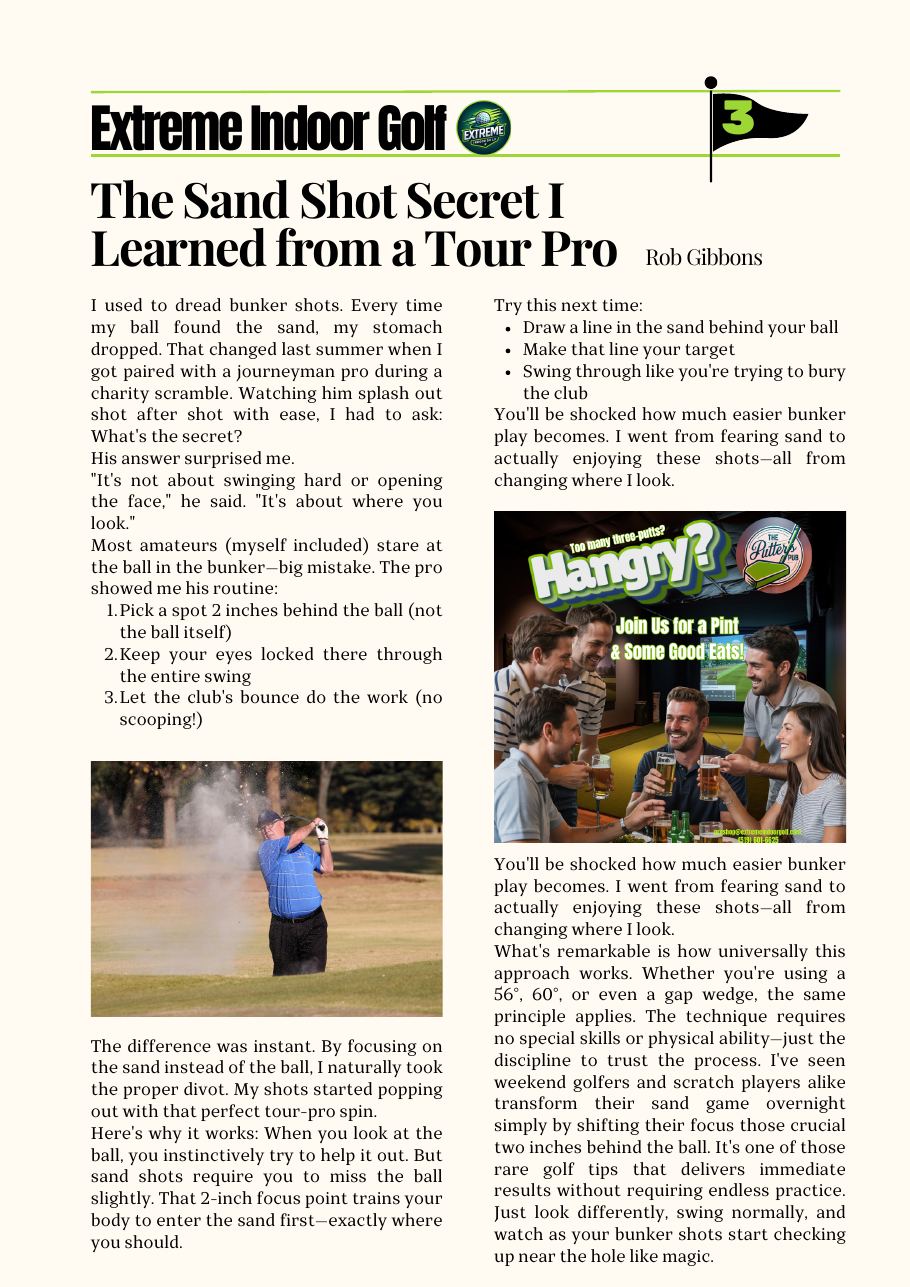
Extreme Indoor Golf I used to dread bunker shots. Every time my ball found the sand, my stomach dropped. That changed last summer when I got paired with a journeyman pro during a charity scramble. Watching him splash out shot after shot with ease, I had to ask: What's the secret? His answer surprised me. "It's not about swinging hard or opening
the face," he said. "It's about where you look." Most amateurs (myself included) stare at the ball in the bunker, big mistake. The pro showed me his routine: 1.Pick a spot 2 inches behind the ball (not the ball itself) 2.Keep your eyes locked there through the entire swing 3.Let the club's bounce do the work (no scooping!)
The difference was instant. By focusing on the sand instead of the ball, I naturally took the proper divot. My shots started popping out with that perfect tour-pro spin. Here's why it works: When you look at the ball, you instinctively try to help it out. But sand shots require you to miss the ball slightly. That 2-inch focus point trains your
body to enter the sand first, exactly where you should. The Sand Shot Secret ILearned from a Tour Pro Try this next time: Draw a line in the sand behind your ball Make that line your target Swing through like you're trying to bury the club You'll be shocked how much easier bunker play becomes. I went from fearing sand to actually enjoying these shots, all from
changing where I look. 3 You'll be shocked how much easier bunker play becomes. I went from fearing sand to actually enjoying these shots, all from changing where I look. What's remarkable is how universally this approach works. Whether you're using a 56°, 60°, or even a gap wedge, the same principle applies. The technique requires
no special skills or physical ability, just the discipline to trust the process. I've seen weekend golfers and scratch players alike transform their sand game overnight simply by shifting their focus those crucial two inches behind the ball. It's one of those rare golf tips that delivers immediate results without requiring endless practice.
Just look differently, swing normally, and watch as your bunker shots start checking up near the hole like magic. Rob Gibbons
View original page design
Page 4
Readable transcript
Is Your Practice Green Lying to You? Extreme Indoor Golf You've been draining putts all week on your office carpet or indoor putting mat. Then you get to the course, and suddenly, you can't buy a make. Sound familiar? The truth is, most practice greens, especially indoor ones, don't prepare you for real course conditions. The perfect, flat
surfaces and consistent speeds create false confidence. Here's how to bridge the gap: 1. Understand the Differences Outdoor greens have grain, slope, and imperfections. Practice on surfaces with some texture, try putting on a rug or uneven carpet to simulate real breaks. 2. Transfer Your Skills Focus on stroke mechanics indoors, then
adapt to outdoor speeds. Start each practice session with ten lag putts to gauge the day's green speed. 3. Simple Translation Drills Place a coin 2 feet away and make 10 in a row (builds confidence) Putt to a tee without letting the ball roll past (controls distance) 4. Equipment Tweaks Consider a slightly heavier putter for
faster greens, or adjust your ball position for slower surfaces. Don't let your practice green fool you, train for reality, and watch your scores drop. 4 The Unsexy GolfShot That ActuallyWorks There's a pivotal revelation when golfers discover simplicity as their secret weapon. I learned watching a senior player save par
while I floundered with fancy wedges. His weapon? The bump-and-run – golf's dependable technique overshadowed by today's wedge obsession. This isn't complex. It's returning to fundamentals previous generations mastered. The technique: mid-iron, ball back in stance, putting motion. What you lose in spin, you gain in reliability.
When I added this to my game, the impact was immediate. Those practiced wedge shots became unnecessary around most greens. The bump-and-run excels on tight lies where wedges dig, and on quick greens. Without worrying about perfect contact, you focus solely on distance. That's why experienced players choose this while high
handicappers reach for their lob wedge. Next round, try this: take your 7-iron, think extended putt, and watch how often you finish closer than with wedges. The least spectacular shots often save strokes. Gary Joseph Gordon L. Kier
View original page design