Searchable HTML
February 2026 Newsletter
Searchable HTML edition of February 2026 Newsletter from Extreme Indoor Golf in London, Ontario.
Searchable HTML edition: All document text is available below. Open the original page design only when you want the visual layout.
Page 1
Readable transcript
Extreme Indoor Golf Patrick Reed to Return to the PGA Tour? Speculation is growing around a possible return of Patrick Reed to the PGA Tour, reigniting debate across the golf world. Once a prominent figure on the Tour and a major champion, Reed has spent the past few seasons competing primarily on the LIV Golf circuit after joining the
breakaway league in 2022. Now, with professional golf continuing to evolve, questions are emerging about whether a PGA Tour comeback could be on the horizon. Reed’s departure from the PGA Tour was one of the most controversial moves during the early days of LIV Golf. Known for his competitive edge and outspoken personality, he became both a fan favorite
and a polarizing figure. Since making the switch, Reed has remained active in global events, including major championships where eligibility allows, but his absence from regular PGA Tour competition has been noticeable. Recent developments in the ongoing negotiations between the PGA Tour, LIV Golf, and global golf stakeholders have
fueled renewed speculation. While no official announcement has been made, the possibility of pathways opening for LIV players to return has led many to wonder if Reed would be among the first to take advantage of such changes. His strong performances in select events suggest his game remains sharp enough to compete at the highest level.
A return to the PGA Tour would not be without challenges. Reed’s relationship with fans and fellow players has often been strained, and questions remain about how he would be received. However, from a competitive standpoint, his résumé speaks for itself. With a Masters title, multiple Tour wins, and a reputation as a fierce match-play competitor, Reed would
instantly add intrigue to any field he joins. For now, Patrick Reed’s future remains uncertain. Whether he stays committed to LIV Golf or seeks a return to the PGA Tour, his next move will be closely watched. One thing is clear: any decision Reed makes is likely to generate headlines and stir conversation throughout the golf world
EDITION 12 February NEWSLETTER K e v i n W a l t o n
View original page design

Page 2
Readable transcript
E x t r e m e In d o o r G o lf BGolf has always been a game of feel, patience, and repetition. For decades, players relied on instinct, trial and error, and the occasional lesson to improve their swing. Today, that approach is rapidly evolving. Welcome to the era of data-driven golf, where AI swing analysis and launch-monitor
technology are transforming how players practice and improve. Modern golf technology tracks everything from swing path and clubface angle to ball speed, launch angle, and spin rate. Instead of guessing why a shot sliced or came up short, golfers now get immediate, objective feedback. AI-powered systems analyze patterns over time, helping players
understand not just what went wrong, but why, and how to fix it. This shift doesn’t replace feel; it enhances it. Old-school golfers learned through repetition alone, often reinforcing bad habits without realizing it. Today’s players combine feel with data intelligence, accelerating improvement and building confidence faster than ever before.
That’s where indoor golf experiences are leading the way. At Extreme Indoor Golf, you’re not just guessing your swing speed, you’re seeing it in real time. Every shot becomes a learning opportunity, backed by precise data and instant insights. As technology continues to evolve, one thing is clear: the future of golf belongs to those
who blend tradition with technology. Data isn’t changing the soul of the game, it’s sharpening it. S c h e f f l e r C l a i m s A m e r i c a n E x p r e s s T i t l e With his win at The American Express on Sunday, Scottie Scheffler etched his name deeper into golf’s history books yet again. The world No. 1 delivered a commanding
performance at PGA West in La Quinta, California, finishing four shots clear of the field to claim his 20th career PGA Tour victory. Scheffler’s final round showcased his trademark consistency and composure. After beginning the day just off the lead, he surged ahead with a string of birdies and never relinquished control down the
stretch. His closing 66 (6-under par) was more than enough to separate himself from the pack and reaffirm his status as the game’s top player. The victory marked a major milestone in an already remarkable career. At just 29 years old, Scheffler has now accumulated 20 PGA Tour wins and four major championships before turning 30, a feat achieved
previously by only Tiger Woods and Jack Nicklaus. Beyond the historical significance, the win came with tangible rewards. Scheffler earned a winner’s share of more than $1.65 million and valuable FedExCup points, while also surpassing $100 million in career PGA Tour earnings, placing him among an elite group of all-time greats.
As the season begins, Scheffler’s latest triumph sets a powerful tone. With his blend of precision, poise, and relentless consistency, he appears poised for yet another dominant year on tour. 2 T h e R i s e o f D a t a - D r i v e n G o l f a n d A I S w i n g A n a l y s i s Gordon L. Kier R y a n M c T a v i s h
View original page design

Page 3
Readable transcript
E x t r e m e In d o o r G o lf Golf is experiencing a powerful shift, and women are at the center of it. Across all levels of the game, female participation is growing faster than ever, driven by expanded junior-girls programs, increased LPGA visibility, and welcoming social-golf communities that emphasize fun and inclusion over tradition and exclusivity.
Media coverage of women’s golf has reached new heights, introducing fans to inspiring athletes and compelling competition. At the same time, grassroots efforts, from local leagues to beginner- friendly clinics, are creating accessible entry points for women who may have once felt the game wasn’t designed for them. These changes are reshaping golf’s
culture and broadening its appeal. The rise of indoor and social golf experiences has also played a key role. Flexible formats, relaxed environments, and technology-assisted play remove many of the barriers that once discouraged new participants. At Extreme Indoor Golf, we’re seeing more new golfers than ever, and
we love it. It’s a clear sign that golf truly is for everyone. More women on the range doesn’t just mean more players; it means a stronger, more diverse future for the sport. As participation grows, so does innovation, community, and opportunity. Golf’s evolution is underway, and inclusivity is proving to be one of its greatest strengths.
Women’s Golf IsChanging the Game Golf’s off-season is officially a thing of the past. Indoor simulators have moved from niche training tools to a core part of modern golf culture, giving players a way to swing year-round without worrying about weather or daylight. Today’s golfers want more than just practice, they want a
social, tech-driven experience that blends competition, entertainment, and connection. Indoor golf delivers exactly that. High-tech simulators provide real-time swing data and realistic course play, while relaxed, lounge-style environments turn practice sessions into social hangouts. It’s where serious golfers sharpen their game and
casual players come to have fun. Why wait for spring? The bays are warm, the beer’s cold, and your swing doesn’t need hibernation. At Extreme Indoor Golf, indoor bays make it easy to play, practice, and party all in one place. Indoor golf isn’t replacing the traditional game, it’s expanding it. And for a growing number of players, it’s become the new
normal. . 3 J a m i e L e e Indoor Golf IsRedefining the Year-Round Game K e v i n W a l t o n
View original page design
Page 4
Readable transcript
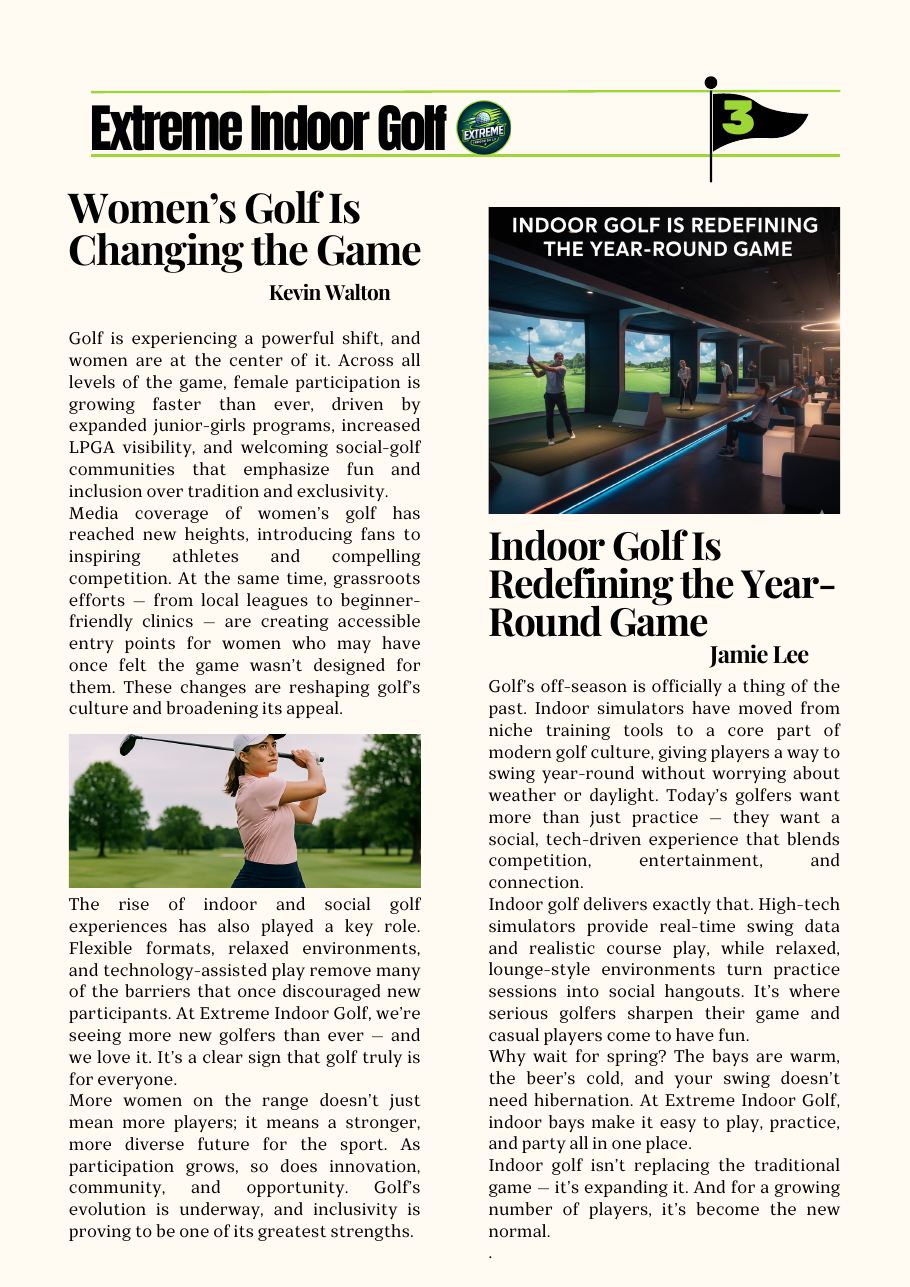
Golf Fitness and Mobility Training Arethe New Game Changers E x t r e m e In d o o r G o lf For years, golfers believed the secret to better scores lived entirely in the swing. Grip tweaks, stance adjustments, and endless range sessions were the go-to solutions. Today, that mindset is changing fast. From tour professionals to weekend
warriors, golfers are realizing it’s not just about how you swing, it’s about the body behind the swing. Modern golf fitness focuses on mobility, stability, and core control. Improved hip rotation, thoracic spine mobility, and shoulder stability allow golfers to generate power more efficiently while reducing strain on the body. Instead of forcing
distance through brute strength, players are unlocking effortless speed by moving better. This shift has transformed how golfers train. Stretching routines, rotational exercises, balance work, and controlled strength training are now considered essential tools, just like clubs in the bag. The benefits go beyond added distance.
Better mobility leads to improved tempo, more consistent ball striking, and greater durability throughout a long season, or even a long weekend of back-to-back rounds. 4 What’s driving this evolution is a better understanding of injury prevention. Golf places repetitive stress on the lower back, hips, and shoulders. Without proper
mobility and strength, even casual golfers can develop nagging issues that limit performance and enjoyment. Fitness training helps players stay healthier, swing freer, and enjoy the game longer. Technology has also played a role. Launch monitors and simulators clearly show how body movement impacts swing mechanics, making fitness gains immediately visible.
You don’t need a gym membership to train smarter, your best swing starts with how you move. At Extreme Indoor Golf, golfers can work on range of motion, tempo, and balance right in the simulator bay while seeing real-time feedback on every swing. Stretch, strengthen, and swing like a pro, golf fitness is quickly becoming the new
must-have gear in the bag. As players embrace smarter training, the game is evolving into one that rewards movement quality just as much as technique. The future of golf isn’t just stronger swings, it’s healthier, more athletic ones. T . L o p e z
View original page design